


Belly Dance Through the Ages
Since this conversation delves deeper into multiple scholarly genres, the way this article presents itself is by first addressing common questions I was once asked on the Sexualization of Bellydance. This will soon be followed by a scholarly elucidation of Bellydances or as I would like to call it, Folk dances from an Egyptian lens. The second segment will not only introduce you to what dances looked like before its whitewashing, but also weigh in with conversations around imbibed perceptions of gender and sexuality prevalent in Egyptian society before, during and after colonization.

If you wish to skip the first half of this scholarly edition, you can do so by watching this interview which highlights almost everything that I have detailed out in the first section.
SEXUALIZED HISTORY
Etymology
We begin our journey with the term "Belly dance". Often used to describe folk dances hailing from Middle Eastern regions, this terminology is quite the newbie- its earliest mention was as a nickname provided by French troops in North Africa to dance forms seen around the region. The French nickname being danse du ventre which translates to the dance of the belly, was initially a term that was used to categorize dance forms from Berber and other North African regions.
Around the 1850s is when dans du ventre first appeared in print and thereafter, immediately became common knowledge. Take a look at a translated pamphlet that was circulated between 1850-1912 in France, entitled "African Negro".

One of the famous Orientalist works was in 1864, a painting, "The Dance of the Almeh" by Jean-Léon Gérôme. By 1864, this term was used to characterize any dance hailing from North African countries, Turkey, Syria, Lebanon, Iraq. A few years hence, is where we gain the term Bellydance from: it entered the English language as a translation in 1883.

The Greeks also had a terminology and they categorized the dances as Kelikos horos, however, it wasn't a widespread term known among all Europeans. We do see another term, tsifteteli also being used by the Greeks.
You may have heard of Raqs Sharqi which was coined in the 1920s. Often attributed to Badia Masabni, it translates to dance of the East. We can perhaps trace the origins of Dance Orientale/Oriental Dance to this form. There are a lot of politics associated with Raqs Sharqi which we will get into much later. Raqs Beledi however, exists as a contrast to Raqs Sharqi. It is also used in conjuction with Raqs Masri, meaning Dance of Egypt.
Fast-forward to the 1970s, Americans wanted to divorce the dance form from the term "Bellydance" and instead called it Arabic Dance even though most of the dancers weren't Arabic. However, we do see a mention of a dance form termed as Raqs-e-Arabi in Iran. Since, the orientalists weren't done, they also termed it briefly as Turkish Dance which now represents series of dance forms colloquially termed under that umbrella. Let's not forget Middle Eastern Dance or what it was later termed as Middle Eastern and North African Dance, as if the dance components are solely based out of the Middle East. Andrea Deagon began her own form, borrowing dance elements from bellydance and appropriating it into SITA (Solo - Improvised - Torso - Articulation).
Now that we have covered almost all White-appropriation of the dance form (if I have missed out on any, do write to me. I shall include them all here on the Wall of Shame), let us dive into how everyone of these interpretations and definitions of the dance form is absolutely wrong.

Now, everyone of these definitions talk about a woman, undulating her belly or hips, often a dance form associated with the Middle East. What people don't mention is that it isn't one type of dance, but a colloquial term used to define several dance forms. It is also heavily gendered, with no mention of men dancing as well. Furthermore, we are zoned into the representation of the Middle East, when we forget that a greater part of the choreography also includes chest undulations which travelled all the way from India, through the Suez Canal, to then be classified as Bellydance.
How would you define orientalism?
The term Orient was used to define countries on the East, namely Asian and Middle East countries. However, “Occident” was used to define the West, namely European countries and the US. But what about West Africa: why isn’t it considered an “occident”? Well, racism. It is a very Eurocentric approach. Europe was taken as a starting point and all the countries were measured wrt Europe’s position. So we had “Middle-East” and “Far-East”.
According to Said, Orient was not just a geographical term, it marked the peak of colonialism. “The Orient is not only adjacent to Europe; it is also the place of Europe’s greatest, richest and oldest colonies, the source of its civilizations and languages, its cultural contestant, and one of its deepest and most recurring images of the “Other”. The grueling point here was the need to think of non-European societies as so far removed from being civilized, that it warranted colonization. In fact, in my opinion, there was a need to feminize and sexualize these cultures in order to justify colonization.
How has it historically shaped Western perceptions of the world?
What we term as belly dance, only came into the English language in 1883. It was translated from a French term: “dance du ventre” which was coined in 1864 as a nickname to an artwork: “La danse de l'almée” (The Dance of the Almeh) by Jean-Léon Gérôme. There is no equivalent to the word “belly dance” in African languages or in Arabic.
Let me take it one step ahead for you. In Egypt alone, there are about 31+ different types of folk dances. And they were colloquially termed as “Belly dance” for the ease of understanding of the orientalists. So let’s look at the definitions of “belly dance” provided to us today by the internet.
Oxford Dictionary: “a dance originating in the Middle East, typically performed by a woman and involving undulating movements of the belly and rapid gyration of the hips.”
Cambridge Dictionary: “the activity of performing a type of dance originally from Western Asia in which a woman moves her hips and stomach”
Dictionary.com: “a solo dance of Middle Eastern origin, performed by a woman with midriff exposed, emphasizing movements of the pelvis and abdominal muscles.” “a sensuous and provocative dance of Middle Eastern origin, performed by women, with undulating movements of the hips and abdomen.”
What about Chest undulations provided to us by countries in Asia. What about similar styles of dances provided to us by India? The language singles out only the Middle east. It further draws more attention to the hips and the belly of the dancer. It also specifies only “Women”.
In essence the Orient has been used to define a contrasting image of Europe with respect to ideas, personalities, experiences, etc. It wasn’t until 2009 and 2016, when New York former Governor Paterson and Former President Obama, had “Oriental” stricken from NY State and Federal Laws, respectively.
Even today, when he hear the word “Oriental”, we think of East-Asians as that was the American ideology propagated, which featured xenophobia, violence, anti-Asian sentiments.
The fact that we do not hear much about “occidental” speaks volumes to how exotified and othered were the nations to the East.
Document the Clothing Evolution in Belly dance
Belly dance, as we now know is nothing but an Orientalist interpretation of art forms existing in Africa and Asia. Its clothing, laden with themes from the Harem fantasy, skewed with a generic Gypsy vibe, and cross-pollinated with shisha mirrors from India, mozunas from Morocco, or coins (which had nothing to do with the dance).
Most interpretations of clothing from these regions hail from Orientalist fantasies. As we have just seen, the coin belt used in belly dance is also of a questionable origin. Which begs the question, how native were the cabaret and burlesque stylized clothing in this dance form?
Instead of providing you with a straight-forward, simple answer, let me invite you on a journey. Let us first travel to Egypt to witness the clothing evolution over the years.
While Galabeya is fairly common in Egypt, certain tribes had their own influence on the attire. For example, the Bedouin tribe that had influenced dances such as Razaa, Dahia, Mashreqiya, Al Razaa and Al Khogaar, adorned a thobe, which are similar to the Levant region's thobe however, varying in its embroidery.

How has Western attitudes on Sexuality and Gender affected the perception of the dance?
Where do I begin? In 1834, King Muhammad Ali banned the ghawazee dancers from Cairo. They were forced to move to Upper Egypt. This led to a rise in Male dancers like Egyptian khawals (khawalat) and the ginks, who were of other backgrounds (Jews, Armenians, Greeks and Turks). Do we hear about them? No. They were mostly absent from European literature as the visitors were only interested in observing what they had defined as a sexualized aspect of the dance.
"An adult male, not a youth whom he saw twice, once in a wedding procession and, later, performing in the Hotel d'Orient in Cairo... Flaubert found Hasan's performance possessed high artistry." (quote from Kathleen Fraser "Before they were Belly Dancers", p. 82).
Pic 1: Photo of a khawal, dating to before 1907, Egypt
Pic 2: Egyptian dancer in front of a divan, c.1870s, unidentified photographer
Pic 3: Egyptian male dancer, Khawal. Photo by Wilhelm Hammerschmidt, Cairo. 1860 - 1869
“The dancing girls appeared in a cloud of dust and tobacco smoke. As their heels beat upon the ground, with a tinkle of little bells and anklets, their raised arms quivered in harmony, their hips shook with a voluptuous movement; their form seemed bare under the muslin between the little jacket and the low loose girdle….They twirled about so quickly that it was hard to distinguish the features of these seductive creatures, whose fingers shook little cymbals, as large as castanets, as they gestured boldly to the... strains of flute and tambourine. Two of them seemed particularly beautiful; they held themselves proudly; their Arab eyes were brightened by kohl, their full yet delicate cheeks were lightly painted. But the third I must admit betrayed the less gentle sex by a week old beard, and when I looked into the matter carefully... it did not take me long to discover, that the dancing girls were, in point of fact, all males” - Gérard de Nerval (1808 - 1855) at a Café in Cairo.
During the Ottoman period, clothing too, had drastically changed from Assuit, open meshes made of cotton and linen (3150-2613 BCE) to Galabeya, a white garment that fully covers the Almeha dancers or to Entari (covered but the chest portion was cut open) worn by the Ghawazee dancers. Now to clarify here. Almeha dancers were mostly found in Cairo and Ghawazee mostly near the Delta region of Egypt. Ghawazee were street performers, while the awalem were restricted to the palaces. Ghawazee, like the Gypsy dancers, were part of a nomadic tribe (Nawari people) that traveled from India to Egypt, and it was quite normal for them to dance in the streets with an entari as they weren’t sexualized earlier until the rise of Orientalism.
The Oriental fantasy featuring the exotic East and fairs, circuses for the entertainment of well, mostly white men, was where I began researching this topic. There were a series of photographs and postcards that have survived from the 1800s of women with their breasts out. Whether consent was provided is unclear. One of the famous photo prints were of Lev and Fils, which they had titled as “Moorish” meaning “ of the black skin/black hair”.
Sexualization & Instrumentalization of the Middle East
In one of my thesis, I am exploring the need for colonization and the justification thus provided to colonize from the lens sexualization and feminization of the Global South.
Post the fall of Constantinople on May 29, 1453, the leftover Roman Empire, and its admirers, the European Empires, set out on a quest to colonize the East in order to maintain long-term trade routes. They didn't however, forget the Empire that got them into this destitute state- the Ottomans. Ever since there has been a narrative: a narrative of the West as the Savior, the East that needs saving; a narrative where the West is the all-time powerful being fueled by the sacrifices of the East; a narrative where the Western religion is the one true God while the Eastern religion, Islam is the Devil; and finally the narrative of the West as the Active Force, Masculine, the Penetrator, and the East as the Passive Force, Feminine and the Defiled.
This dichotomy in observing the world with the lens of the East vs West Civilization Philosophy, has led us to today, where we not only observe the East in a particular light, but we take comfort in painting her as sexualized, mythical, irrational and ungovernable. This comfort is where we begin our assault on the existent religion, science, culture, food, linguistics, dance, music and art, to shadow it with our beliefs, prejudice and perceptions, so as to confine this entity into a boundary that it accepts as the new normal.

Delacroix, is famously known to have painted Algerian women of the harem. However, this painting has “evoked both desire for the harem women and repulsion at the Orient’s inferior social and political systems.” For centuries, Middle Eastern women have been painted and pictured without their consent, reducing their identities to mere post-cards that were sent back to Europe to titillate and thus invite more Europeans to journey through Middle East.
The allure of this painting lies in the aspect that Delacroix was able to infiltrate the harem, and unveil its women so as to paint their bodies. It was indeed observed as a breech of sanctity of the Algerian society. This solidified the French imperial control over Algerian soil.
Throughout the 1950s, we see an emergence of the "White Knight in shining armour" analogy being used by European colonizers, so as to mask the war crimes, torture, massacre, military interventions and genocide under the umbrella of "moral crusades", to dehumanize and delegitimize the Muslim existence.
“To say simply that Orientalism was a rationalization of colonial rule is to ignore the extent to which colonial rule was justified in advance by Orientalism, rather than after the fact.”― Edward W. Said, Orientalism
Censorship on film
Around the 1800s, Hollywood took a special interest in bellydance, so much so that for decades the industry only produced films featuring either too much sex or too much violence. Fatima's Coochee-Coochee Dance by Edison, released in1896, featuring a Ghawazee dancer was the first ever censored film.
In fact, Dolorita’s Passion Dance (1897) was the first banned film in the US, banned in Atlantic City and New Jersey on the grounds that the dancer's very movements served to inflame passion…
By the time the prohibition was issued, Dolorita’s Passion Dance was the most viewed kinetograph the parlor had ever hosted, while its notoriety was assured as early as May, when a Mr. W. J. D. Standifer of Butte, Montana, approached one of Edison's East Coast distributors to ask whether the company had any material that might appeal to clientele of that rough’n’ready copper mining town. Back came the reply: “We are confident that Dolorita’s Passion Dance would be as exciting as you desire. In fact, we will not show it in our parlor. You speak of the class of trade which want something of this character. We think this will certainly answer your purposes. A man in Buffalo has one of these films and informs us that he frequently has forty or fifty men waiting in line to see it.” Dolorita, incidentally, remained clothed throughout her performance.
Unfortunately, I couldn't find any video online of Dolorita's Passion Dance.
Before the categorization of all middle eastern dances as bellydance, we do know that the term derives itself from a French term being used to classify North African dance forms. I think it is important that we travel to said North African regions, specifically Berber and Algeria to understand more about the sexualized history of Belly dance.
Oueled Nail
Pronounced as "will-ed nah-eel", the tribe that had gone through great lengths to ensure a safe travel for their women from Berber to Algeria, was recorded to have converted to Islam in the 7th-8th centuries CE. The tribe, mostly consisting of women had baffled the French and their pre-held notions of gender and sexuality.
"[The] Ouled Nail, with her robe of vivid crimson embroidered in gold, her soft silk veil of the palest blue…the wide gold girdle with its innumerable chains and pendants, the necklaces of coins, the bracelets of silver and gold, and the crown-like head-dress, is the personification of the gorgeous East." – Frank Edward Johnson, Here and There in Northern Africa (The National Geographic Magazine, January 1914)

America's Obsession with the Sexualization
In the Encyclopaedia Sexualis, MD Victor Robinson had described in detail a “bride-elect” dance, essentially, a sex dance done by the bride onto the groom.
In the US, this exotification sky rockets with the introduction of fallacies such as “only the young and pretty, slim and even toned women can bellydance”. In fact, there was a massive attempt to modernize an Islamic society during the Oriental period, great reforms were being made, including outlawing ghawazee dancers. There seems to be a picturesque depiction of the “orient” in paintings, almost as if it was stuck in time, or rather displayed as backward in comparison to the “white man”... a complete erasure of history, of the inventions and the modern societies that existed to further drive a whitewashed narrative of what is considered as a civilized society and what isn’t.
Let us delve in a bit further. Here are some myths that are evidently made visible when perceiving this artform:
Bellydance is performed by women
Bellydance is performed by beautiful people
You need to expose your midriff, look sexy and sensual while dancing
Beautiful people do not need props to dance. Props are used by ugly people to divert your attention from them
If you are plus size don’t bother dancing as the floor might cave in underneath you
Belly dance helps build fertility and in delivery
If you want the world to take you seriously, you will not engage in such exotic dances
Belly dance is a harem dance fantasy
If a man dances, it will immediately make you feminine
Every bit of this- is a MYTH. Mass hysteria propagated by an uneducated public. The whole notion that even in dance, a woman’s worth is tied down to a hole that needs to be filled or a hole that births, is ridiculous. The idea that one’s masculinity is linked to the type of dance you perform, again hysteria. All these are inherently European ideologies spread across the world and masked as normal states of existence while traditional, indigenous ways of life was seen as abnormal.
What are some examples of cultural misappropriation in the way bellydance is practiced or portrayed outside its original context? Whose narratives are lost when we speak of the dance as “belly dance”?
When we speak of “belly dance” we reference only the “golden era” of dancers which were heavily influenced by burlesque and cabaret dance. While we do have Ghawazee, Hajella, Melaya Leff, Semsemiya, Bambotiya, Dahia, Mashraqia, Gypsy, Beledi, Saidi, Kaffaffa, Burmia Baharia, Hosit, Bedouin, Nubian and many more folk dances from the Egyptian belt, none would be considered as Oriental.
The term Oriental dance and the choreography came from the palaces, caliphs of Baghdad where several jawari dancers were kept as slaves, concubines. It basically was the product of the Abbasid harem. It then spread across the trade routes and was introduced as Oriental Dance, inaccurately described as belly dance and vice versa. We also have an Oriental Belly dance which is a mish-mash of everything.
In essence, the terminologies were distorted, many folk dances have lost their essence in the modern world and the media recognizes a colloquial term today: Belly dance which was again an Orientalist’s way of classifying us.
There also seems to be a wave of misinformation and cultural appropriation taking place with respect to distorted viewpoints regarding clothing and perceptions of the dance form which I will go into depth when we speak about the role of Feminism in developing a distorted view of an art form.
Even when Feminism decided to adopt Bellydance into its practice, it did so by glorifying prot-feminist ideologies about womanhood. In one of my previous works on the Witchy Archetypes, I dig deeper into the patriarchal constraints within which feminism is allowed to operate. For example, with the narrative of the witches of the 21st century, we see them being recast into femme-specific job profiles and roles.
We see a similar approach with regard to belly dance where there exists a femme-specific space that a woman can inhabit and an existence beyond that is unfathomable. For example with belly dance, we see these myths of it being used for fertility: as a tool to aid in childbirth or the myth of sexualization.
The takeaways here is that from an oriental lens women can exist only in two spheres: a mother and a man’s fantasy. Glorification of the dance with these lenses can only propagate the ideals of the male gaze. In essence the dance form existed devoid of any association to childbirth, fertility or even sexuality. It existed as a narrative: a narrative of feelings, souls, emotions and connection: a narrative that was essential to the survivability of a human civilization.
How does orientalism intersect with issues of race, sexuality, and identity politics?
Racial Stereotyping: Orientalism often racializes the peoples of the East, portraying them as inherently different from Westerners. These racial stereotypes position Eastern peoples as inferior, passive, and mysterious, reinforcing a racial hierarchy that privileges whiteness.
Colonial Power Dynamics: Orientalism emerged during a period of European colonial expansion, where racial superiority was used to justify colonial domination. The depiction of Eastern societies as backward and in need of Western intervention served to legitimize the colonial project.
Exoticization of Eastern Sexuality: Orientalist depictions frequently eroticize and fetishize Eastern sexuality, portraying it as both alluring and deviant. This exoticization often manifests in Western art, literature, and media, where Eastern women are depicted as hypersexualized, submissive, and available, while Eastern men are portrayed as either overly virile or effeminate.
Gendered Power Relations: The sexualization of the Orient is deeply tied to gendered power dynamics. It reflects and reinforces Western patriarchal views, where the "Oriental" woman is often depicted as an object of desire, subjected to the control and gaze of the Western male.
Construction of the Other: Orientalism is a form of cultural identity politics, where the West constructs its identity in opposition to an imagined Orient. This binary opposition not only defines the East but also reaffirms the West's sense of superiority and modernity.
Intersectionality: For people of Eastern descent living in Western societies, Orientalism intersects with their racial, sexual, and cultural identities, leading to complex experiences of marginalization. They may face stereotypes that impact their self-perception and social interactions, influencing how they navigate their identities within a Western context.
Global Politics and Islamophobia: In modern times, Orientalism continues to influence global politics, particularly in the context of Islamophobia and the "War on Terror." Muslims and people from Middle Eastern backgrounds are often subjected to Orientalist stereotypes that portray them as threats to Western civilization.
Cultural Appropriation: Orientalism also manifests in the appropriation of Eastern cultures in Western fashion, art, and entertainment, where Eastern symbols and practices are often stripped of their cultural significance and commodified for Western consumption.
Decolonizing Knowledge: Scholars, activists, and artists from the Global South and diasporic communities have challenged Orientalist narratives by reclaiming their histories, cultures, and identities. This involves deconstructing Orientalist tropes and promoting alternative representations that reflect the diversity and complexity of Eastern societies.
Intersectional Movements: Intersectional approaches in feminism, queer theory, and postcolonial studies highlight how Orientalism intersects with other forms of oppression, such as sexism, homophobia, and classism, advocating for a more nuanced understanding of these issues.
BELLYDANCE THROUGH THE AGES
What factors influence the dancing style?
The main factors influencing a folk dance would be the Geography, Climate, Politics, Traditions and Customs.
For example, in a desert, having a hot and dry climate, loose sand, a dance such as the Hajella emerging from here, would involve the dancers laying their feet flat on the ground and never tip-toeing.
However, a dance emerging in a desert that has mountains, since it is easier to climb the mountains on your toes, dancers would be found on their toes, with their hands outstretched. In comparison to the dances born indoors, inside a house specifically, due to constraints in space, dancers would not extend their hands beyond their body frame. Many would adopt clapping instead of outstretched hands.
Dances born from coastal regions, or ones closer to a large body involves a pace that often appears nervous as the dance aims to imitate the movement of the water body.
When we look at climate, those who live cooler/colder regions birthe faster dances as opposed to those living in arid climates. A faster pace, leads to more warmth in the body, a slower pace conserves energy dissipation, making you feel colder. We see that in Nubian dances, where only about 1-3 parts of their bodies are being used at a given moment, in order to prevent overexertion.
Societies that live in regions that are both cold and arid, incorporate fast and slow choreography into their dance style.
Regions that were war zones, often present dancers in a single line, as a metaphor to suggest the last line of defense against any invasion (check out the Dabke dance from Palestine).
These regions may also incorporate battle formations into their dance to boost the spirit of the warriors, convey strength, unity and cultural pride (Haka, the Māori dance).
Monotheistic religious dancers include turns and circles in their choreography. On the other hand, polytheistic dancers dance in half-circles or even in lines.
The positioning of the audience is also very interesting. Sometimes we see the audience stand in a circle around the dancer - this ensures the dancer's safety. A dance that was portrayed on a stage/platform, positioned in front of the audience/ slightly away from the audience- ensures the audience safety and their held beliefs being protected.
What Belly dance really is referring to:
What we call belly dance, was an overarching term created by Orientalists to classify similar rhythmic and movement dances together for ease of their understanding. In Egypt alone there are about 31 (and still counting) different types of folk dances, each native to a specific region of Egypt.

Marsa Matrouh Region
Haggala/Hajjelah
Birthed itself in the Marsa Matrouh region, which is closer to Libya, Hajalah, a Libyan word, refers to a hopping dance. The Hajalah is occasionally seen in both the East and the West deserts. There are no orchestra present during the performance, except for the odd "Ney" (an end-blown flute), Magroudah and/or tabla. The men are often seen clapping for the performer (a woman), the claps provide a rhythm according to which she can choreograph her performance. The claps draw the dancer. Usually there are groups of men competing for the dancer's attention. To draw her to your group, the group needs to clap loudly- louder the claps, the more attention you receive from the dancer. A dance step which was later appropriated into the "modern Bellydance", was the 3/4 shimmy that was popularized by these haggala dancers.
One of the famous interviews with Dr. Tamer Aziz, an Egyptian Anthropologist and Kinesiologist, yielded him talking about what it takes to dance the hagalla. I am paraphrasing below and translating his answer from Arabic to English.
Adult Movements are restrictive and commonly fall under three categories: one, we use everyday in walking, eating, etc; two, we use these for war so as to attack and defend; and third, we use it in sports and aesthetic kinetic expression. A child's however, is spontaneous, the roots to any kinetic movement. The moment a child is clad in clothes, it is stripped of its natural, spontaneous, God-given movements. This prison that we call clothing limits the child to adopt socially acceptable movements. When you compare the movements of a city dwelling child with those of a cave-dweller, you can notice the stark difference in the limitations imposed, thus restricting the breadth of movement the child can display. To indulge in Hagalla is to get in touch with that inner child, the child unburdened with clothes, the child free to express the movements it has been blessed with by Mother Nature.
Alexandria City
Melaya Leff
Funnily, Melaya Leff isn't a folk dance. It was a fairly new interpretation of a theatrical dance from based out of Alexandria, created by the choreographer, Mahmud Reda (1930-2020). A major . It stands as a homage to the fisherman communities, giving them a chance at representation at a national level. Let's dissect the term Melaya first. Melaya refers to a large sheet of fabric while leff refers to wrapping it around the body. This was a garment worn over one shoulder, exposing one arm which could be used in acquiring payments. It was a very common garment worn by the sex workers at Alexandria when the dance was first presented on stage.
While the Reda troupe, made its debut in 1959, Melaya Leff wasn't seen until a few years later. It centers itself around a young woman from Alexandria, which would explain the misconception that all the girls wore a melaya, which they did not - they did however, wear dresses with short sleeves, adopting the garment style that was heavily influenced by European fashion at Alexandria at that time. If a performance displays all the women in the skit in a melaya, it is referring to the sex workers of the region, which is untrue. The Melaya Leff organized by the Reda troupe opened with 6 children, dressed in an old Cairo style- boys wearing vests and trousers, while girls adorned in dresses, followed by a syrup vender clad in baggy pants (sarouelles). While engaging with the children, the young woman, which was portrayed by Farida Fahmy, enters with a melaya draped across one shoulder, coquettish, inviting the vendor to flirt with her instead of selling syrup. While buying the syrup, the vendor accidentally spills some onto her melaya, which she drops agitatedly, to make use of her hands, to voice her frustration.

This act of dropping the melaya, soon became an idiom- tefresh lo el melaya, which meant "to cast the melaya aside, to free the hands, and allow the woman space to move her hands angrily to communicate her frustration towards her adversary".
Alexandrian Dance
Melaya Leff is sometimes colloquially referenced as Alexandrian but the two don't have any similarities other than that they were born from the same city. Alexandrian dance is often performed by men, using the dance ornamentation of the knife, a prop, as a homage to the fisherman communities, giving them a chance at representation at a national level. The dance form imitates the flow of the sea and its tides - the highs and lows, with dancers incorporating calmness/stillness of the water with sudden jumps and short runs. Sometimes, you may see a borrowing of other props such as chairs or a sticks. With sticks specifically, the dancers borrow certain acrobatic poses associated with Nakrazan dance, which is a rarely visible acrobatic folk dance of Egypt - often makes its appearance in other dance forms, perhaps as a trip down the memory lane. When incorporating the Nakrazan piece into Alexandrian, dancers would balance the long stick on their nose, mouth or shoulder, and then proceed with the dance.
When we compare Alexandrian Dance to the Coast Dances, we see some stark differences
Port Said Ismailia Suez
Henna Dance
Observed in the Suez city first, followed by its induction into the Delta and Cairo culture, Henna dance is predominantly visible during wedding ceremonies or even the celebration of a baby. Henna Dance can be mainly found in cultures living in the Al Arish, Suez city, Kafr El Sheikh, North Delta and a few in Alexandria.
Unlike the Indian Henna parties, in Egypt, this dance is mostly performed by men of the wedding parties. It is believed that the Suez canal offered a transport for the migration of cultures. Some are of the belief that this dance hails from India, while others state that nomadic tribes from the Suez canal travelled East to share their dance with countries like India. As a result of it, the henna dance is referred to as a Transcultural dance.
I belong to the tribe that believes henna originated in Egypt as there is significant evidence to support that the paste was used during the mummification of bodies in ancient Egypt. However, to counter my argument, I am aware that those who believe that the origins of henna wasn't in Egypt base their arguments on the three major ports of entry used by foreign tribes to enter Egypt: North, North East and South. With the Northern migration, through the Sinai peninsula, we had an influx of the Bedouin tribes into Egypt via Al-Arish city or Suez city.
Similar to Indian Henna celebrations, some of the Egyptian celebrations involve hiding gold coins in a henna tray and filling it up with water, followed by asking the bride to find the said coins - the coins are meant to be a support system for the bride in case of any difficulties she may face post the marriage. Men when they dance, they use the tray as a prop, twirling it around their back, over their heads - it is generally a group of men outside the bride's home dancing with the henna tray that will soon be used to apply henna on her.
When one compares henna dances of the past and the present, one would find that early dances that originated in the Suez canal invoked the use of folk songs with some percussion beats, however, by the time Henna dance reached Kafr El Sheikh, it had modernized, to be accompanied by a musical recording/film songs/remixes. So to summarize, Bedouin tribes in North Egypt moved from the Suez to Kafr El Sheikh to Delta to Alexandria.
In the South of Egypt however, Henna celebrations were brought in by the Nubians. It is a misconception that henna was only applied on the bride - grooms to have henna applied to their feet and hands.
Om Al Kholoo
Let us travel to Ismailia. Just as it was with Alexandria, with the continuous looming threat of invaders, the art forms of Ismailia, resonated with the same fear. The dance also reflected the local fishermen's tools and movements.
While these fishermen cast their triangular nets, mounted on a stick into the shallow ends of the sea, they would manage to catch a few seashells. They would then rapidly move the stick back and forth, holding it with two hands, to shake off any sand collected in the nets. This helped them obtain cleaner sea shells, which could then be cut open and the meat sold in the market nearby. Just as these fishermen, these dancers of this region would hold a tall stick and rapidly move it back and forth in front of them.
The dance would also involve dancers dancing in a straight line - which is indicative of the locals fears of an impending attack - often suggesting that they are the last line of defense against an offensive force that may threaten the country.
Bambotiya Dance
Bambotiya specifically, began as a rhythmic rendition, involving a spoon and several bottles filled with varying volumes of water. Sometimes the singer, while playing this instrument, would stand up and make a movement with one or two spoon/s. Bambotiya transformed into a world famous dance in 1964. Its story is rather very interesting.
While the Reda Troupe was already functional in the 1950s, Egypt in order to construct its own folk dance image - took the help of the Soviets, inviting them through to Ismailia. Under the direction of Boris Ramazin, a Soviet dancer, al-Firqat-al-Qawmiyyat was founded in 1961 to represent a dance company in the image of Moiseyev, but with a pinch of Egyptian. The Russian dance that was chosen for imitation was the peasant's lozhki dance, ложки (the dancer was called lozhkar, ложкарь), often performed with 3 spoons (some use about 4-15 as well!). The difference between the Russian and Egyptian dance forms were that the former used wooden spoons while the latter used metal spoons.
“Representation itself implies a kind of power, the power to define, to describe, to act on behalf of someone else. Describing particular forms of dance as folk dance for example carries certain historical and political connotations”- Gillian Bottomley (1987)
In a colonial society of Egypt, with the embodiment of a unique blend of idealistic European values of propriety, culture and gendered attitudes, a huge impact was endured by the dancing community and their art. Many faced extinction, while others were frowned upon for being too sexual, and overtly empowering for women of the said society. Shay claims that Reda consciously and specifically attempted to erase the equation of dancer, male or female, with prostitution, by erasing or altering any movements he perceived as overtly sexual.
“The reputation of dance [in Egypt] was terrible. We decided to avoid the strong movements of the belly and hips, and we covered the dancers.”- Mahmud Reda (1930)
As far as Egypt's reputation goes, as seen on the world platform for folk dances, one might say that a spoon is mightier than the sword.
Semsemiya Dance
Semsemiya as well, is a musical instrument based dance, that was brought in from Upper Egypt.
Based out of Ismailia, it incorporates Bambotiya dance steps with handkerchiefs as the main prop. It almost looks like the men at the docks, who used trade with these sailors, were either greeting them or saying goodbye.
Sinai Peninsula (Eastern Desert)
The Sinai Peninsula is divided into 3 major regions: Arish area, El Teah and El Toor. "Teah" refers to a maze; this mountainous region cannot be easily navigated through unless you know your whereabouts thoroughly. To note here that although, Gypsy dances are found in the Sinai peninsula, refer to the Delta region, to receive a thorough download on the Gypsy tribes. The dances of the Sinai peninsula also vary based on the regions, however, some regions show similarities:
Arish Region consists of Razaa, Dahia and Mashreqiya
El Teah consists of Dahia and Mashreqiya
El Toor consists of Al Saamer, which in turn is further divided into 2 different dances- Al Razaa and Al Khogaar

As we know by now, the politics of the region highly influences the music and dance. Being one of the entry ports into Africa, the Sinai peninsula was a war-front zone for several years. A simple manner to observe the socio-political influence on dance is to see if the choreography is performed in a circle or in a line. We do have several other interacting factors like the geography of the region, the climate, and the beliefs and habits of people. However, generally, with folk dances, regions prone to war, display line dances. The musical instruments used in the area includes the Rababa, Shbbaba, Maqrouna/Magrouna, Lute, Doff and Tabla.
Al Dahia/Tahia/Dahio/Dahaiyyah
Al Dahai = offering salutations/greetings in English. This word was introduced to the Egyptians via the Bedouin tribes. It didn't quite feature into the lifestyles of those living in the North or South of Egypt, however, it spread from the East to the West, including South Sinai: specifically in Delta tribes like Al Dawagrah and Al Shamilat. It involves a line of men standing in front of the dancer/s and clapping until the dancer/s starts dancing in front of them (again in a line), to which the response of the man is to sit down and clap, provide her the beat she needs to dance. She then moves away to perhaps another line of men, and when she returns to the previous one, the men would sit down again to provide her with the beat she needs.
Al Maskraqiya
Similar to the Al Razaa, Al Mashraqiya involves longer poems and the male dancers sitting down and standing up on a loop. Sometimes as they clap for the two dancers, they also move their bodies back and forth.
Al Marbouaa
Similar to the Mashraqiya and Razaa, Al Marbouaa, is a competition between dancers to see who can last longer without collapsing. It is now extinct, and has not been danced in years in Egypt.
Al Khogaar
Characterized by 2 line of men standing in front of each other with women dancing in semi circles in the middle, Al Khogaar's rhythm is defined by the claps and the poems chanted. At a given time, each woman is facing just one line of men as she narrates her poem. I suppose the purpose is to test the two lines of men to check which one can keep up with the poem and provide the right rhythm to support the dance the women perform. Since, we have lost touch with the dialect that used to be spoken in this region, no one knows what "Al Khogaar" means.
Al Razaa
"Razaa" refers to a type of a loud clapping. It involves, 2 semi circles of men clapping and chanting a poem, while a woman faces them, dances to the beat of the claps with a sword. The two circles can also be seen to move sideways to the rhythm of the claps. One can also speculate that as it is with Khogaar, Razaa was also a competition to observe which circle can perfectly guide their woman to their beat.
Razaa is now extinct and not visible in the Sinai peninsula. What we do have are stories and explanations from the older generations on how this dance is to performed.
Debka
It appeared North of Sinai, with an influx of tribes from the Levant area. It involves a group men standing in one line, with the one in the front taking the lead, by holding the stick, dancing forward, sideways and back to the back of the line. Each dancer gets an opportunity to dance in the middle, before making their way back to the line. Remember this list highlights only the dances of Egypt: like Debka several other dances too, have multiple variations of the dance form based on the region it is practiced in.
Nile Delta Region
A peculiarity of the Nile Delta region is that it acts as the doorway to Egypt for several Eastern and Western Empires. Due to the influx of people from different cultures, the music, forms of dance or expressive movements of people of this region are very different from folk dances across Egypt. For example, many Arab families in this region settled here, upon travelling from Greece. The dances of the Nile Delta region comprise of Oriental Dance, Awalim, Ghawazee, Gypsy and Fallahi.
Ghawazee
Ghawazee is said to have travelled from Bahrain and Iran, and found a home in the Nile Delta region. The Ghawazee dancers were particularly targeted during colonization. They are believed to be the matriarchal Nawar tribe that travelled from India> Pakistan> Persia> Egypt. The word Ghawazee in Arabic means invader. On the contrary to the nomadic image I am painting here, Ghawazee families today are found only in Egypt—making them look like they are baladi (authentically Egyptian).
Being one of the most targeted minorities in Egypt, the Ghawazee were particularly banned from Cairo by the King in the 1830s, as Egypt began its quest through modernity by adopting the need to be modest. They eventually settled in Luxor-Saidi regions, and began incorporating several Saidi dance iconographies into Ghawazee.
They are two major Ghawazee families, descendants of one lives in Delta (Sunbat's sons), while the other can be found in Luxor (Mazen's daughters). There is also a mention of a third group, living in Assuit or near Al Minya. However, the evidence suggesting for a third family could be contested. A sub-group of this tribe were named Almeh.
Ghawazee is now considered as a sub-group of the Saidi dance form. Its been over 3 centuries and Ghawazee has remained pretty much the same — unlike Raqs Sharqi and the Cabaret styled Belly dance, Ghawazee has had no "outside" influence. To that regard it is often considered baladi.
After the ban on Ghawazee dancers in the capitol, there was an increasing need for street dancers for entertainment, which led to the emergence of Khawalat (men who cross-dressed as women, particularly the Ghawazee dancers) to fill in the vacancy. Ghawazee as an art form, if it is alive today, owes its remembrance to these Khawalat dancers — for without whom, the dance would have surely been wiped out from public view.
The story of countless Ghawazee dancers being targeted by Napoleon's troops were one of the many that were burned into my memory. Although, one must clarify that literature on women, sex workers and ghawazee dancers aren't particularly reliable sources. The ones, that speak of atrocities faced by the dancers also label all sex workers as Ghawazee when not all ghawazee dancers engaged in sex work.
It was June 1799, when General Dugua, the Governor of Cairo, wrote to Napolean that the commander of Bulaq barracks was complaining of the increased number of sex workers spreading STDs. In the letter, he mentioned that he had consulted with the Aga of the Janissaaries (Chief of Cairo Police) who had advised him to adopt the "Turkish method". The General was eager to find an alternative path and was asking Napolean if he had any advise to which Napolean replied, "Ask Aga to deal with it."
The gist of the story was that with the increase in STI/STD cases within the French army, Napolean had ordered all sex workers with infections to be disposed off as a punishment for giving his army STDs. The "Turkish method" being beheading the sex workers (who were all colloquially called Ghawazee) and drowning them in a sack.
Gypsy Dance
Gypsy dancers on the other hand, hailed from the nomadic ghaggar/jaggar tribe of India, originating their journey in the Indus Valley civilization where the Ghaggar-Hakra river (commonly mislabelled as the Saraswati river) used to flow. Meanwhile the gypsy musicians were of the Dom/Domba caste in India. The tribe came to be living in the Sinai peninsula could be traced to Palestine, prior to that Syria, and all the way back to India. We also see some of these gypsy tribes in north-west African countries. The tribe was known as musical wanderers for centuries before they landed in Egypt. Commonly called as gypsies, they suffered the similar fate as their counterparts in Europe.
Quite often we see people using the term Gypsy and Ghawazee almost interchangeably — today, a lot of Gypsy dance and music representation are being rebranded as Ghawazee, perhaps as an attempt to counter the prejudice Gypsies had to endure over the years. One major difference between the two, is that Gypsy tribes were commonly found in the desert, and would sometimes venture into the city, while the Ghawazee families lived in cities.
Further, if Gypsy tribes and Ghawazee families shared the same ancestry, their groups could be existent in similar regions. Although we see Gypsy tribes and Ghawazee families in both the Delta region (Cairo) as well as in Upper Egypt (Luxor), we do not see Ghawazee families in the Sinai peninsula which feature plenty of Gypsy tribes living in the desert. Thus, proving the point that these groups exist independently in Egypt.
Known for surviving the harshest of the climates, Gypsy dancers choreographed their performances to resemble their life on the desert— the dances were rough, raw, powerful and fast. As a contrast, the Ghawazee dancers enjoyed the comfort of the cities, which reflected in their choreographies. IF we take it a notch further, the Almeh, living in the palaces had a much more relaxed approach to the dance than the Ghawazee dancers.
Finally, something of note here is that in comparison to the Ghawazee performance, the Gypsy performances included a larger variation in their musical compositions—owing to their adaptive nature. Gypsies would often adapt their style of music to suit the target audience's needs so that their compositions were well received by the cities they travelled to. On the other hand, if one were to analyze their languages, Gypsy tribes did speak more of the traditional form of Arabic, as opposed to the more modern variety spoken by the Ghawazee families.
Cairo
Now as a melting pot of cultures, Cairo housed a mix of artisan communities and residential families. Many dance forms such as Baladi, Awalim, Oriental and even Ghawazee was found here.
Baladi Dance
Baladi or Beledi (as it is pronounced) is what we colloquially refer to local dances even today. Often found in Cairo, Delta and Alexandria, Baladi dance is often associated with Melaya Leff (a dark fabric wrapped around the body). The wrapping style would often vary based on which region is referenced. Baladi is often performed inside houses, at weddings, and other functions by women. One might say Baladi dance is the precursor for development of what we call Belly Dance and Oriental Dance today.

It is important for us to differentiate between Baladi, Belly dance and Oriental Dance for these terms are often used interchangeably and do not do much justice to the breadth of choreographies covered by respective dance forms.
Oriental Dance
Oriental Dance was a result of Jawari dancers choreographing and adapting local dances (Baladi Dance) for the Abbasid Caliphate. Hence Oriental Dance is also referred to as the Eastern Dance, as it was initially platformed in the harems of Abbasid Caliphate (750-1258). To note here, the caliphate also platformed several other dancers like the Qayna dancers (singular: Qiyan) and the Awalem dancers. It was only during the Citadel Massacre of 19th century, that we see mass migrations of Jawari and Awalem dancers into Egypt. It is also important to note that today there exists many Oriental dance forms like the Lebanon, Egypt, Syria, Turkey and Iraq.

Today, Oriental dance looks very different based on where they are platformed; i.e., they vary if they are platformed in weddings/family functions vs platformed in night clubs.
Awalim/Awalem Dance (s. Almeh)
From an etymological standpoint, we are unsure if Awalim, the name has Egyptian or Arabic Roots: in Arabic, Awalem means "words" while in Egyptian, it means "a group of people who know everything about anything". Awalim (s. Almeh) are groups of dancers, musicians and singers. Early European travelers often confused mischaracterized the Awalim. Edward William Lane, recorded that the orientalist accounts of the Awalim only included the dancers and failed to record the musicians and singers.

In 1798, when French troops landed in Egypt, many Ghawazee and Awalim dance families relocated from Alexandria, Cairo and Delta to Upper Egypt. However, some scholars like Tamer Aziz, suggest that some Awalim families did return to Cairo once they had encountered French scholars who wished to study the Awalim lives. 1801, Pasha, who ruled Egypt, suggested that Awalim and Ghawazee dancers could return and resume their profession. It is said that many Awalim dancers began hiring Ghawazee dancers to dance in their parties but since the expenditure was taking a toll, Awalim dancers began learning a few Ghawazee choreographies to be able to independently host parties, dance, perform music and sing. It was not easy juggling all these roles and as a result some Awalim dancers decided to stop dancing.
During Mohammad Ali's time, it was forbidden for the dancers to enter houses, and all performances were done outside the house. In some cases, if there was a need to enter, only the Awalim dancers could, but they were confined to a particular area of the house to stage their performance. Egyptian households had strict rules to ensure the respectability of the woman is not compromised. Only Awalim women were allowed into the women's quarters (occasionally). This exposure to the women of the household, allowed women to learn the Awalim choreographies, leading to what we call as Baladi Dance today.

March 1,1811, Mohammad Ali killed all the Mamluks, in what we call as the Citadel Massacre today. As to how many mamluks were killed. The closest survey I could find was that of 1798, as reported by Dr. Aziz, which pointed that Cairo's population was 250,000-260,000. Of which, before the French arrived, Mamluk population was estimated to be 6000 and Janissary corps, about 12000.
Mohammad Ali then ordered the reconstruction of the Al Sayeda Zeinab area (behind the citadel), nearby Al Hussein Bazaar, to accommodate his loyalists in the palaces on one side and the workers, working in the palaces on the other side of the Mohammad Ali Street. Alongside workers, several artists, musicians and dancers (settling down in the Haret al-Awalim, Quarter for Female Dancers) relocated to this street. For further detailed accounts of Awalem dancers, you can check out, Al Muṣawwar Magazine, which had published an article on the "State of Awaleem Dancers" in October 28 1958. I tried searching the archives for the 1958 release but was unsuccessful. The archives however has 504 Al Muṣawwar magazine releases.

For my report, in 2023, I visited the Harel Al-Awalem (where the Awalim dancers used to stay). I had gone there to take some photographic evidence however, my photos and videos that I had uploaded, have been wiped clean by the government. — Tamer Aziz, Folk Dance researcher and choreographer
By the 20th century, every Awalim family had a Ma'lima, a boss woman, generally the owner of the establishment such as coffee houses or the manager of dance & music troupes. When playing the character of a Ma'lima, quite often the dancer assumes masc. qualities because of the authority and power held by the Ma'lima. She would often be seated in coffee houses, smoking shisha, wearing a white galabeya.
Upper Egypt
Due to close proximity to the Nubian Desert, many dances that use a stick as a prop can be found in this region. As such these dances are called Raqset el Asaya (dances of the stick). However, as we see below, dances vary from their point of origin such as Luxor, Aswan, Nile valley, hence when mentioning Raqset el Asaya, it is important to also specify "Raqset el Asaya from where".
Saidi Dance
Saidi refers to farmers or people of the South (Upper Egypt). The dance is also referred to as Ghawazee Saidi. However, as clarified by Dr. Aziz, women of Upper Egypt are not allowed to dance in front of foreigners (referencing anyone who is not from Upper Egypt) but can in closed quarters. In some cases, only those allowed, quite often are from Ghawazee and Gypsy families. So Ghawazee Saidi refers to Upper Egypt Ghawazee dancers, while Ghawazee refers to Ghawazee dancers living in the Delta region. If you remember, Ghawazee dancers are dancers living inside the city while Gypsy dancers are ones living outside the city.
Tahteib Game (commonly misclassified as a dance)
Although practiced across Egypt, even in Delta, Alexandria and Cairo, like for example El Fayyum, Beni Suef, El Giza, Banha, Shibin el Kom, Tanta, Damanhur, El Mansura, Zagazig, Ismaila, Suez, Ra's Sudr, Ra's Ghareb, Bawiti, El Minya, Tahteib is commonly associated with villages of Upper Egypt. While this game is practiced across, a Tahtieb game in Delta and one in Upper Egypt will have very different rules.

One of the oldest references to Tahteib game (almost 5000 years old) can be found in the Ti tomb, Saqqara, near Abusir, north of Saqqara (500 m North West of the Step Pyramid of Djoser). This Mastaba of Ti, discovered in 1865, is probably of a senior official in the era of the last kings of the 5th Dynasty (dated circa 2350-2100 BCE as per pottery inscriptions and styles). In fact, due to variations in the game, in Alexandria, one must declare to the judge which set of rules apply to the game, is it Delta, El Fayoub or Upper Egypt rules. The rules often state touching which part of the body with one's asaya/assaya/nabboot (stick) results in a point. Sticks are usually 3 cm long. It is assumed that the stick was commonly used as a training tool back in the day by soldiers. In Upper Egypt, it is forbidden to touch the face, while in Delta one can touch the face.

Hosheeb / Housiet/ Tarbala
Al Ababda tribe, once a nomadic tribe, now found in Shalateen, Marsa-Alam, East of Aswan and perhaps even in Halayeeb, like the other tribes (Kawalah, Manasir, Hassan & Hadendowa) originally hailed from the region between Berber and Abu Hamad, Sudan. Journey to Egypt, might have started at Mograt Islands in Sudan, close to Abu Hamad. It is suggested that when the valley dried up, the Arab tribes started relocating. The journey would have possibly taken them to Berber, then Karima, Dongola, to Wadi Halfa, before they made their way into Egypt. When in Egypt, they settled in Halayib, Shalatin, Marsa Alam and even East Aswan. Please visit the link, t know more about the Origin of Ababda.

Hosheeb is a type of sword dance performed during festivities and to welcome guests. Also known as maggad or sayf. A group of singers form a line in front of the two dancers who perform a choreographed fight with swords (sometimes with shields), sticks or long rods. Those in line clap rhythmically and stamp their feet as they sing.
Shakreeb
Another dance form commonly observed among the Ababda Tribe, is the Shakreeb. It involves a line of Ababda men (of whom one plays the tanboura) facing 2 dancers. They jump high and rhythmically clap their hands. It is a competition where one tries to out-jump the other. Jumping is seen as a sign of virility. Sometimes, women spectators are found ululating.
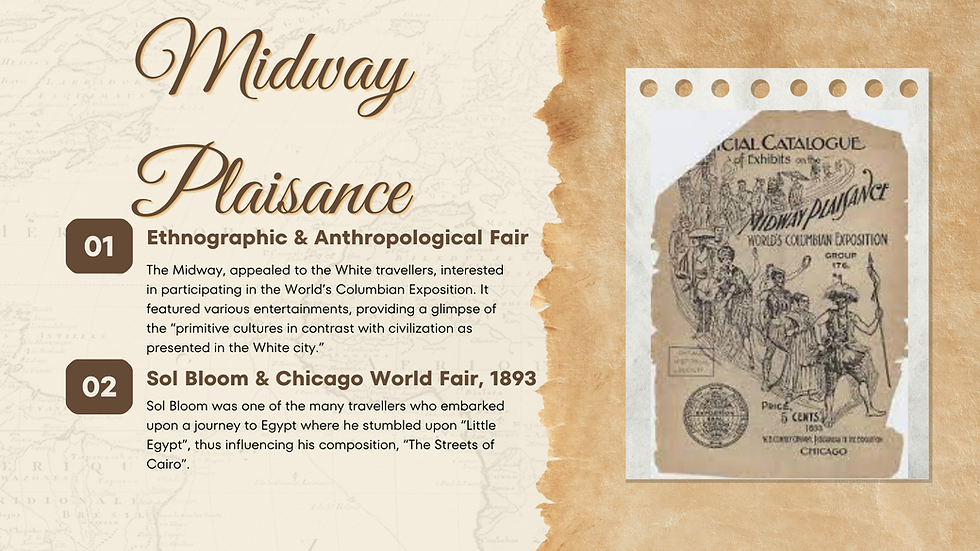
Midway Plaisance
[note this section is under construction]
Of course, our main focus is on the 1893 World Fair, however there were 3 others before that that greatly influenced the manner in which the 1893 fair was set up.
1851 World Fair
It displayed the Great Exhibition of the Works of Industry of All Nations or the Crystal Palace Exhibition. It was set up at the Hyde Park, London, from May 1 to October 15, 1851. It was the first in the series of World Fairs. One of the controversial pieces of exhibit here was the world's largest diamond, Koh-i-Noor, which was looted by the British in 1849. 1851, is probably the first time the diamond was presented to the world. Apparently, Prince Philip was not impressed by its shape and had ordered it to be re-cut as an oval by the Royal Coster Diamonds.
The last Anglo-Sikh War was fought by Maharaj Duleep Singh's army at Lahore against the East India Company of Britain. The Maharaja was only 10 years old when he lost the war, and under duress was forced to sign the Last Treaty of Lahore, ceding his rights to the Koh-i-noor diamond. The British still claim that the diamond was procured legally, and that they have full rights over it. It sits on the British crown today.

1876 World Fair
It disp

And then bellydance was brought to New York and staged as "hootchie kootchie". While Princeton Union spoke about "hellish contortions", Bloom termed the movements as "abdominal gyrations".


By the early 19th Century and all the way till the 20th, bellydance procured an overtly sexualized reputation. https://babel.hathitrust.org/cgi/pt?id=uva.x004083258&seq=195
Adolphs, R. (2001). The neurobiology of social cognition. Current Opinion in Neurobiology, 11(2), 231–239.
Adum, P. Assuit (Tulle Bitalli) fabric—An Egyptian textile art. www.shira.net.
Bateson, P., & Gluckman, P. (2012). Plasticity and robustness in development and evolution. International Journal of Epidemiology, 41(1), 219–223.
Beauvoir, S. de. (1949). The second sex.
Boone, J. A. (2014). The homoerotics of orientalism. Columbia University Press.
Bracton, H. de. (1968). De legibus et consuetudinibus Angliae (On the laws and customs of England) (Vol. 4). Selden Society.
Bunson, M. (1991). The encyclopedia of ancient Egypt. Gramercy Books.
Chisholm, M. (1982). Modern world development: A geographical perspective. Rowman & Littlefield.
Clot, A. B. (1840). Aperçu général sur l’Égypte (A General Overview of Egypt) (Vol. 2). Meline, Cans et Compagnie.
Criado-Perez, C. (2019). Invisible women: Data bias in a world designed for men. Abrams Press.
David, R. (2007). Handbook to life in ancient Egypt. Oxford University Press.
Elnashar, E., Yoakim, J. B., & Shoman, A. M. F. (2014). Utilization of aesthetics value of tally woven fabric structures in fashion trends. Applied Researches in Technics, Technologies, and Education, 2(4), 318.
Fraser, K. W. (2014). Before they were belly dancers: European accounts of female entertainers in Egypt, 1760–1870. University of Texas Press.
Greg, T. (2007). The sexual demon of colonial power: Pan-African embodiment and erotic schemes of empire. Indiana University Press.
Hanna, J. L. (1988). Dance, sex, and gender: Signs of identity, dominance, defiance, and desire. University of Chicago Press.
Jarmakani, A. (2008). Imagining Arab womanhood: The cultural mythology of veils, harems, and belly dancers in the U.S. Palgrave Macmillan.
Kipling, R. (1940). Rudyard Kipling's verse (Definitive ed.). Doubleday.
Krishna, T. M. (2013). A southern music: The Karnatic story. HarperCollins Publishers India.
Lende, D. H., & Downey, G. (2012). The encultured brain: An introduction to neuroanthropology. MIT Press.
McClintock, A. (1995). Imperial leather: Race, gender and sexuality in the colonial contest. Routledge.
Metzger, S. (2012). When Men Dance: Choreographing Masculinities Across Borders edited by Jennifer Fisher and Anthony Shay. Dance Research Journal, 44(1), 118–119.
Monterescu, D. (2013). Jacob, Working Out Egypt: Effendi Masculinity and Subject Formation in Colonial Modernity, 1870–1940. Comparative Studies in Society and History, 55(2), 233–235.
Oyěwùmí, O. (1997). The invention of women: Making an African sense of Western gender discourses. University of Minnesota Press.
Purkiss, D. (1996). The witch in history: Early modern and twentieth-century representations. Routledge.
Russett, C. (1991). Sexual science: The Victorian construction of womanhood. Cambridge, MA: Harvard University Press.
Said, E. W. (1994). Orientalism (25th Anniversary ed.). Vintage Books: A division of Random House.
Schiebinger, L. L. (1993). Nature’s body: Gender in the making of modern science (5th pbk. print). Rutgers University Press.
Sellers-Young, B. (2016). Belly dance, pilgrimage, and identity. Palgrave Macmillan.
Sellers-Young, B., & Shay, A. (2016). The Oxford Handbook of Dance and Ethnicity. Oxford University Press.
Shaw, I. (2006). The Oxford history of ancient Egypt. Oxford University Press.
Shay, A. (1995). Dance and Non-Dance: Patterned Movement in Iran and Islam. Iranian Studies, 28(1/2), 61–78. http://www.jstor.org/stable/4310918
Shay, A. (1995). “Bazi-ha-ye Nameyeshi:” Iranian Women’s Theatrical Plays. Dance Research Journal, 27(2), 16–24. https://doi.org/10.2307/1478018
Shay, A. (1999). Parallel Traditions: State Folk Dance Ensembles and Folk Dance in “The Field.” Dance Research Journal, 31(1), 29–56. https://doi.org/10.2307/1478309
Shay, A. (2001). Spreading the Net. Dance Research Journal, 33(1), 93–94. https://doi.org/10.2307/1478864
Shay, A. (2002). Choreographic politics: State folk dance ensembles, representation and power. Wesleyan University Press.
Shay, A., & Sellers-Young, B. (2003). Belly Dance: Orientalism: Exoticism: Self-Exoticism. Dance Research Journal, 35(1), 13–37. http://www.jstor.org/stable/1478477
Shay, A., & Sellers-Young, B. (2005). Belly dance: Orientalism, transnationalism, and harem fantasy. University of Texas Press.
Shay, A. (2006). The Male Dancer in the Middle East and Central Asia. Dance Research Journal, 38(1/2), 137–162. http://www.jstor.org/stable/20444668
Shay, A. (2008). Choreographing, Hypermasculinity in Egypt, Iran, and Uzbekistan. Dance Chronicle, 31(2), 211–238. http://www.jstor.org/stable/25598157
Shay, A. (2008). Dancing across borders: The American fascination with exotic dance forms. McFarland & Co.
Shay, A. (2014). The dangerous lives of public performers: Dancing, sex, and entertainment in the Islamic world (First edition). Palgrave Macmillan.
Shay, A. (2016). Ethno identity dance for sex, fun and profit: Staging popular dances around the world. Palgrave Macmillan.
Shay, A. (2019). The Igor Moiseyev Dance Company: Dancing Diplomats. Intellect. https://doi.org/10.2307/j.ctv36xvxsv
Shay, A. (2021). Dance and Authoritarianism: These Boots Are Made for Dancing. Intellect. http://www.jstor.org/stable/j.ctv36xw6q4
Shay, A. (2021). Staging the Folk: Choreographic Issues of National Representation. Dance Research: The Journal of the Society for Dance Research, 39(2), 222–246. https://www.jstor.org/stable/27127249
Shay, A. (2023). Folk dance and the creation of national identities: Staging the folk. Palgrave Macmillan.
Strudwick, H. (2006). The encyclopedia of ancient Egypt. Metro Books.
Ṭahṭāwī, R. R. (1801–1873). Rifāʻah Rāfiʻ
Talaat, D., & Guibal, C. (2011). Ma liberté de danser: La dernière danseuse d’Egypte. Neuilly-sur-Seine: Michel Lafon.
Tharoor, S. (2018). Inglorious empire. Penguin Books.
Thomas, G. (2007). The sexual demon of colonial power: Pan-African embodiment and erotic schemes of empire. Indiana University Press.
Tooby, J., & DeVore, I. (1987). The reconstruction of hominid behavioral evolution through strategic modeling. In The evolution of human behavior: Primate models (pp. 183–237).
Van De Mieroop, M. (2010). A history of ancient Egypt. Wiley-Blackwell.
Varisco, D. M. (2013). In Z. Elmarsafy, A. Bernard, & D. Attwell (Eds.), Debating orientalism. University of Nebraska Press.
Vives, J. L., Beauchamp, V. W., Hageman, E., Mikesell, M. L., Ffolliott, S., Travitsky, B., & Albanese, D. (2002). The instruction of a Christen woman. University of Illinois Press.
Watterson, B. (2017). Women in ancient Egypt. Amberley Publishing.
Wood, L., & Shay, A. (1976). Danse du Ventre: A Fresh Appraisal. Dance Research Journal, 8(2), 18–30. https://doi.org/10.2307/1478151
Barakat, Halim. 1993. The Arab World: Society, Culture, and State. Berkeley, CA: University of California Press.
Belly Dance Divas. n. d. About Belly Dance. http://www.bellydancedivas.co.za/AboutBellyDance.html. Accessed June 9 2009.
Deloncle, Pierre. 1927. La Caravan Aux Eperons Verts. Paris: Librarie Plon.
Dinet, Etienne, and Sliman Ben Ibrahim. 1926. Khadra. Paris: H. Piazza.
Fromentin, Eugene. 1857 [1981]. Un Eté dans le Sahara. Ed. Anne-Marie Christin. Paris:Le Sycomore.
Gautier, Théophile. 1865 [1978]. Loin de Paris. Ed. G. Charpentier. In Théophile Gautier, Ouvres Completes, vol. 9. Geneva: Slatkine Reprints.
Herodotus. n. d. History. (Public domain.)
Hichens, Robert. 1904. The Garden of Allah. New York: Grosset and Dunlap.
Lazreg, Marnia. 1994. The Eloquence of Silence: Algerian Women in Question. New York: Routledge.
Me’ira. n.d. The World’s Oldest Dance. http://www.bdancer.com/history/BDhist1.html. Accessed June 14 2009.
Meserve, Casey. 2009. Dancing For Themselves. Kingston Reporter. Feb 20.
Michelle. n. d. Collecting Your Dowry. http://www.farfesha.com/pages/dowery.html. Accessed June 1, 2009.
Morgan, Lawrence. 1956 [2001]. Flute of Sand. Bristol, UK: Cinnabar.
van Nieuwkerk, Karin. 1995. A Trade Like Any Other. Austin, Texas:University of Texas Press.
Rashad, Hoda, Magued Osman, and Farzaneh Roudi-Farhini. 2005. Marriage in the Arab World. Population Reference Bureau. http://www.iiav.nl/epublications/2005/MarriageInArabWorld.pdf.
Accessed June 15, 2009.
Scarborough, Milton. 1994. Myth and Modernity. Albany, NY: State University of New York Press.
Hegyi, Klára-Zimányi, Vera: Az oszmán birodalom Európában. Corvina, Budapest, 1986, colour plate 26.
Barrios, Richard. 2003. Screened Out: Playing Gay in Hollywood from Edison to Stonewall. New York and London: Routledge.
Caute, David. 2003. The Dancer Defects: The Struggle for Cultural Supremacy during the Cold War. Oxford and NY: Oxford University Press.
Chauncy, George. 1994. Gay New York: Gender, Urban Culture, and the Making of the Gay Male World, 1890-1940. New York: Basic Books.
Chudnovsky, Mikhael A. 1959. Folk dance Company of the U.S.S.R.: Igor Moiseyev, Art Director. Moscow: Foreign Languages Publishing House.
Corber, Robert J. 1993. In the Name of National Security: Hitchcock, Homophobia, and the Political Construction of Gender in Postwar America. Durham, NC: Duke University Press.
Corber, Robert J. 1997. Homosexuality in Cold War America. Durham, NC: Duke University Press.
Croft, Clare. 2015. Dancers as Diplomats: American Choreography in Cultural Exchange. NY: Oxford University Press.
Cuordileone, K. A. 2005. Manhood and American Political Culture in the Cold War. London and New York: Routledge.
Dean, Robert D. 2001. Imperial Brotherhood: Gender and the Making of Cold War Foreign Policy. Amherst and Boston: University of Massachusetts Press.
D’Emilio, John. 1998. Sexual Politics Sexual communities: The Making of a Homosexual Minority in the United States, 1940-1970. Second Edition. Chicago: University of Chicago Press.
Edelman, Lee. 1993. “Tearooms and Sympathy, or, The Epistemology of the Water Closet.” In Henry Abelove, Michèle Aina Barale, David M. Halperin, editors. The Lesbian and Gay Studies Reader. New York and London: Routledge, 553-574.
Field, Douglas. 2005. “Introduction.” In Douglas Field, editor. American Cold War Culture. Edinburgh, Scotland: Edinburgh University Press, 1-13.
Fisher, Jennifer and Anthony Shay. 2009. “Introduction”. When Men Dance: Choreographing Masculinities Across Borders. Edited by Jennifer Fisher and Anthony Shay. New York: Oxford University Press, 1-47.
Gilbert, James. 2005. Men in the Middle: Searching for Masculinity in the 1950s. Chicago: University of Chicago Press.
Halberstam, David. 1993. The Fifties. NY: The Random House Publishing Group.
Hallinan, Victoria Anne. 2013. “Cold War Cultural Exchange and the Moiseyev Dance Company: American Perception of Soviet Peoples.” Ph.D. Dissertation. Boston: Northeastern University.
Isareva, Margaritia. 1998. “Moiseyev, Igor.” International Encyclopedia of Dance. Oxford University Press, 443-446.
Johnson, David K. 2004. The Lavender Scare: The Cold War Persecution of Gays and Lesbians in the Federal Government. Chicago: Chicago University Press.
Johnson, Steve Neil. 2016. The Blue Parrot. San Bernardino: Clutching Hand Books.
Kairser, Charles. 2007. The Gay Metropolis. NY: Grove Press.
Kimmel, Michael. 1994. Masculinity as Homophobia: Fear, Shame, and Silence in the Construction of Gender Identity. In Harry Brod and Michael Kaufman, editors. Theorizing Masculinities. Thousand Oaks: Sage Publications, 119-141.
Kimmel, Michael. 2006. Manhood in America: A Cultural History. New York and London: Oxford University Press.
Kinsey, Alfred C., Wardell B. Pomeroy, and Clyde E. Martin. 1948. Sexual Behavior in the Human Male. Bloomington: Indiana University Press.
Kinsey, Alfred C., Wardell B. Pomeroy, Martin, Clyde E. and Paul H. Gebhard. 1953. Sexual Behavior in the Human Female. Bloomington: Indiana University Press.
Kisselgoff, Anna. 2006. “A Visionary of Balletic Folk Dance Turns 100.” New York Times, January 8, 2006, C 1, 13.
Kisselgoff, Anna. 1991. “Moiseyev Company Visits with Its Legendary Bravura.” New York Times, September 26, publicity packet.
Kodat, Catherine Gunther. 2015 Don’t Act, Just Dance: The Metapolitics of Cold War Culture. New Brunswick, NJ: Rutgers University Press.
Lanyon, Josh. 2012. A Dangerous Thing. Just Joshin Publishers.
Moiseyev, Igor. 2016. Ya Vspominaiu…Gastrol’ Dlinoiu v Zhizn’. Moscow: Soglasie. Updated edition.
Morris, Gay. 2006. A Game for Dancers: Performing Modernism in the Postwar Years, 1945-1960. Middletown, CT: Wesleyan University Press.
Patterson, James T. 1996. Grand Expectations: The United States, 1945-1974. Oxford and NY: Oxford University Press.
Prevots, Naima. 1998. Dance for Export: Cultural Diplomacy and the Cold War. Hanover, NH: Wesleyan University Press.
Reynolds, Nancy and Malcolm McCormick. 2003. No Fixed Points: Dance in the Twentieth Century. New Haven, CT: Yale University Press.
Richmond, Yale. 1987. U.S.-Soviet Cultural Exchanges, 1958-1986: Who Wins? Boulder, CO: Westview Press.
Saunders, Frances Stonor. 2013. The Cultural Cold War: The CIA and the World of Arts and Letters. NY and London: The New Press.
Shay, Anthony. 2002. Choreographic Politics: State Folk Dance Companies, Representation, and Power. Middletown, CT: Wesleyan University Press.
Shay, Anthony. 2008. Dancing Across Borders: The American Fascination with Exotic Dance Forms. Jefferson, NC: McFarland & Co.
Shay, Anthony. 2014. The Dangerous Lives of Public Performers: Dancing, Sex, and Entertainment in the Middle East. NY: Palgrave Macmillan.
Shay, Anthony. 2016a. “The Spectacularization of Soviet/Russian Folk Dance: Igor Moiseyev and the Invented Tradition of Staged Folk Dance.” In Anthony Shay and Barbara Sellers-Young, editors. The Oxford Handbook of Dance and Ethnicity. New York: Oxford University Press.
Shay, Anthony. 2016b. Ethno Identity Dance for Sex, Fun and Profit: Staging Popular Dances Around the World. London: Palgrave Macmillan.
Shay, Anthony. 2018a. “Raqqas. The Iranian Male Dancer.” Presentation given at Dance Studies Association Conference, July 5-8, 2018.
Shay, Anthony. 2018b. Dancing Diplomats: Igor Moiseyev and the Moiseyev Dance Company: Spectacle, Russian Nationalism, and the Cultural Cold War. London: Intellect Books. Forthcoming.
Summers, Anthony. 1993. Official and Confidential: The Secret Life of J. Edgar Hoover. New York: Putnam.


